

A note: I discuss the film freely below, including its ending.
Just when she stands up to leave her father’s house for the last time, in her beautiful bridal gown, Noriko goes down on her knees and gently bows before her dad. Her father, in his Western suit, squats down to level with her. She thanks him for the love and care he has given her. That scene with that expression on her face is probably the one I’ll remember the most.
It is those watery eyes, that enormous weight of walking away from the familiar, from what she considered for far too long to be permanent. It is that smile she is trying to maintain and failing at, and her struggle to accept that she has to take the next step forward, in the name of tradition, values, and expectations around her.
It is one of the last scenes in Yasujirō Ozu’s 1949 movie, Late Spring. It is the oldest movie I’ve ever watched and my second Ozu. Later I learned it is considered one of his finest.
The movie opens with stillness. Calm scenes from the town, an empty train station, the roof of a temple, Japanese women attending a very traditional ceremony.
Noriko is an unmarried woman in her late 20s living with her widowed father, a professor. She has assumed much of the responsibility for his daily life, and their life together feels complete, fun, and safe to her. Her father and aunt work together to convince her to get married. As part of that effort, they let her believe that her father is planning to remarry himself. The idea disturbs her deeply. For one, she doesn’t believe in remarriage. But more importantly, she sees no reason for this arrangement to end. She is emotionally possessive of a life she has come to think of as permanent.
The film is also postwar Japan in miniature. In 1949, Japan was occupied by Allied forces. Throughout the movie, the tension of a society changing faster than its habits and family structures can comfortably change with it is on display. For example, when Noriko takes a bike ride with a male acquaintance, a huge Coca-Cola sign sits front and center in a shot as they ride toward the beach.
Early in the movie, the professor and his assistant sit on the floor of a traditional Japanese house discussing Friedrich List, a German economist. An electricity company worker interrupts them because he needs to read the meter but it is too high, so he asks for a stool. The professor says List hated bureaucracy. Almost immediately, the utility worker yells from the doorway that the bill is on the counter.
It is a small scene of contrast, but the whole movie seems to exist in this space. A German economist discussed while sitting on the floor of a Japanese house. Modern electrical infrastructure reached with an old stool. A conversation about bureaucracy interrupted by bureaucracy itself. The old and the new exist together.
Later, Noriko and her father attend a traditional Japanese theater performance called Noh. I’ll be honest, I almost fell asleep during it. The performance goes on for several minutes. The movements are restrained, the chanting is slow, and very little seems to happen. This is already not an easy movie to watch with brains trained by phones, doomscrolling, and instant gratification. Only afterward did I realize that was one of the most important scenes in the movie.
During the performance, her father makes eye contact with Ms. Miwa, the woman Noriko has been told he may marry. Until then, his possible remarriage is something she can resist in the abstract. Noriko watches them exchange greetings, and something in her changes for the worse.
After the theater, father and daughter walk together. He is in his dark suit, walking on the smooth, bright concrete path. When her father asks if she wants to grab a bite, Noriko says she has something else to attend to and physically moves away from him in sadness and anger. She starts walking on the gravel beside it, against dark trees in the background in her white dress. She chooses the harder path, quite literally. Before this, they have moved through much of the movie almost as a unit. Now there is a divide.
She then visits her friend, who lives in a Western-style house with Western furniture and offers her a layered cake. Noriko refuses it, on the surface because she is too upset to eat. Coming immediately after an ancient Japanese theatrical performance, and after that physical separation from her father, it is easy to see that the contrast is not accidental.
Noriko herself embodies the contradiction. She is young and modern in many ways, but deeply attached to an older order. Her strongest “rebellion” comes toward the end, when she opens her heart, as much as she can, while crying to her father. She asks him one last time whether they can continue as they are. She says she doesn’t want things to change. She doesn’t want to get married.
Her father gently tells her that this is how people have lived all along. Marriage will be strange and difficult at first, but she will have to build a new happiness for herself.
They are both smiling by the end of the conversation, yet something between them has shifted further apart. The closeness they had earlier in the movie is now gone. There is now a bigger divide.
The movie closes with the father returning from the wedding and sitting alone in a chair, peeling an apple in sadness. The very last scene is the sea, waves crashing against the shore one after another, dynamic, ever-changing, yet somehow remaining the same.
This movie came to me at a time of great change in my own life.
I’ve just walked out of 13 years of employment with Amazon.
There were stretches of those years, some months or years, that I would have happily kept exactly as they were.
In the early days, I used to eat lunch with my teammates, five or six of us, every day. Those days were full of camaraderie and laughter. Then the org structure changed, and we were separated.
There was also a time when we traveled to Vancouver, BC so often that once a customs officer told me I looked familiar. We were a team split mainly across two cities, hence all the travel. Every visit was full of intellectually fulfilling conversations and social activities full of laughter.
Those days, like many others, felt like they would last forever. Of course, against my desire, they all ended, one after another.
Ozu keeps his camera still in scenes. And he doesn’t always cut when the actors leave. Sometimes he shows you something else briefly, then comes back to the room people have just left.
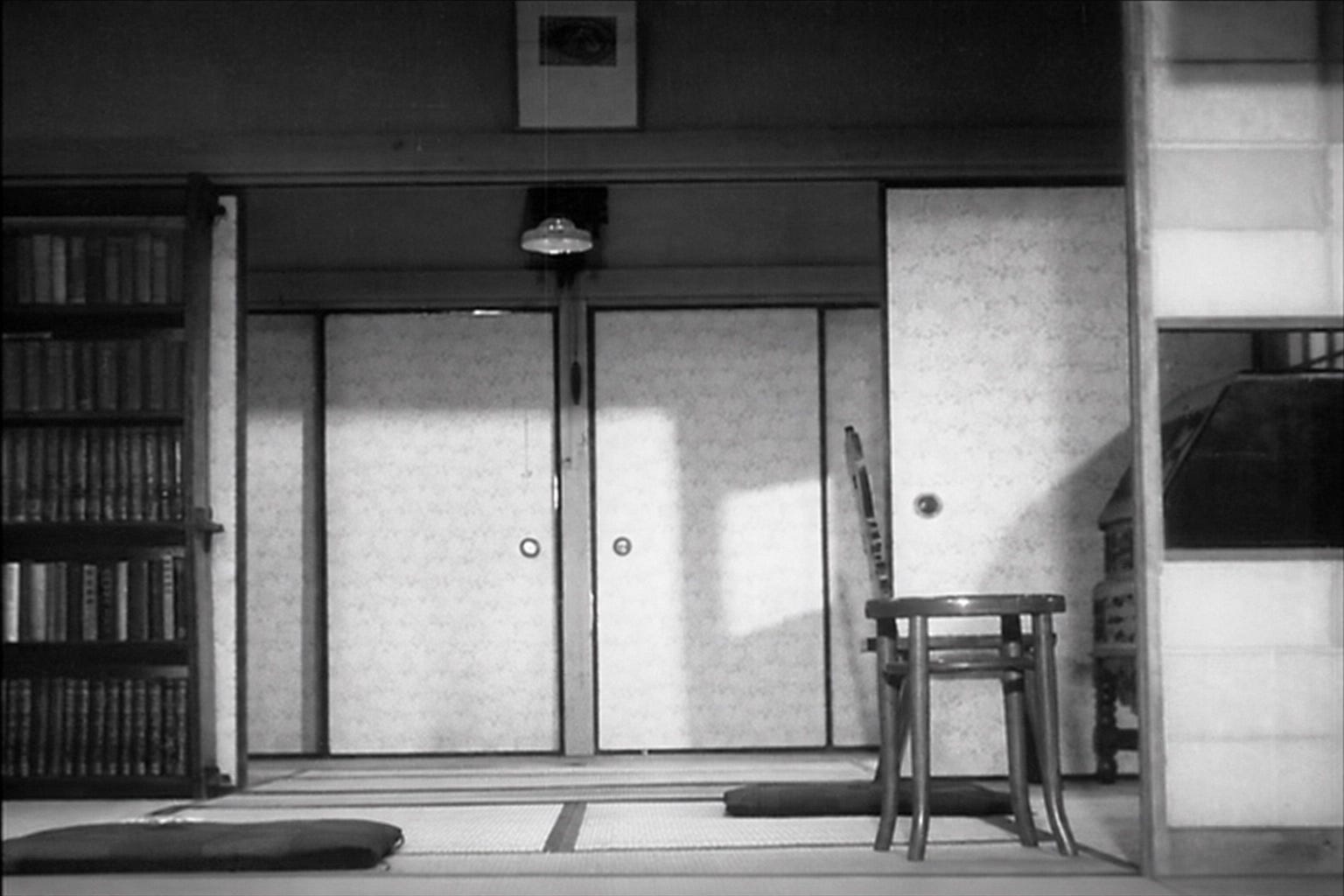
After Noriko leaves the room with her father and aunt, we see the children and neighbors running toward the gate to see the bride. We don’t see Noriko again or the wedding itself. Instead, Ozu returns to the same empty room. He spends several seconds there. In silence.
The stool Noriko was sitting on moments ago is still there.
Does the emptiness take away the fact that just moments ago Noriko took the next big, heavy step of her life in that very same room?
What is left in a room when everyone leaves?
My colleagues, in the weeks following my exit from Amazon, will walk by my office. Maybe some of them will even enter it, and they won’t see me there. My screen will be on my desk, my pen resting on top of my notepad, my chair facing them. Empty.
Does that take away everything we all experienced in that room? In that emptiness, in that moment as they stand in that room, will there be more to it?
I find it very fitting that Ozu, who never married and lived with his mother for much of his life, chose a few years later to move to North Kamakura, where Late Spring is set. His ashes were buried at a temple called Engaku-ji, about a minute’s walk from the train station we see in the opening scene.
I also found out later that there is only one Japanese character on Ozu’s tombstone. One character for mu 無.
A term which is usually translated as “emptiness.”
An emptiness that, Zen philosophy suggests, has everything within it.